Last Updated: November 2, 2026
Quick Summary
To choose dog treats, read the ingredient list first and look for a short list led by a named meat or simple flour, avoiding artificial colors, preservatives, added sugar, and unnamed fillers. Check the guaranteed analysis and calorie statement so you can portion treats to about 10 percent of your dog’s daily calories.
- Ingredients are listed by weight, so the first three or four entries reveal what the treat is made of.
- Avoid BHA, BHT, propyl gallate, corn syrup, and dyes like Red 40 in dog treats.
- Treats should make up no more than about 10 percent of a dog’s daily calories.
- A 600-calorie daily plan gives a 60-calorie treat budget, or two 30-calorie treats.
- Store treats in an airtight container away from heat and moisture and follow the bag’s guidance.
Table of Contents
- Start With the Ingredient List
- How to Read Dog Treat Labels Beyond the Front of the Bag
- How Many Treats Can a Dog Have Per Day?
- Best Treats for Dogs With Sensitive Stomachs
- Match the Treat to Your Dog’s Size, Age, and Chewing Style
- Safety Hazards and Toxic Ingredients Hiding in Treats
- Storage, Freshness, and Sourcing You Can Verify
- Stock Your Treat Jar With Small-Batch Options
- Frequently Asked Questions
Start With the Ingredient List
Knowing what to look for in dog treats starts with one habit: turn the bag over and read the ingredient list before you read anything else. A short, recognizable ingredient list tells you more than any front-of-bag claim ever will. Ingredients are listed by weight, so the first three or four entries reveal what the treat is actually made of. If a named meat or a simple flour leads the list, you are on the right track. If sugar, syrup, or a vague “meat meal” leads, put it back.
Named Meats Beat Vague By-Products
“Chicken” tells you what is in the treat. “Meat by-products” or “animal digest” does not. By-products can include organs and trimmings that vary batch to batch, and the label gives you no way to know the source or quality. Look for a species named outright, and treat “meat meal” without a species as a red flag. A limited-ingredient recipe with one named protein is easier to evaluate and easier on a sensitive dog.
Skip These Dog Treat Ingredients to Avoid
The clearest dog treat ingredients to avoid are artificial colors, artificial preservatives, added sugar, and unnamed fillers. Watch for BHA, BHT, propyl gallate, corn syrup, and dyes like Red 40. None of these make a treat safer or tastier; they exist for shelf life and appearance. For a deeper walkthrough of spotting these on a label, see our guide on how to identify harmful dog treat ingredients.
How to Read Dog Treat Labels Beyond the Front of the Bag
Learning how to read dog treat labels means ignoring the marketing and reading the fine print. Front-of-bag words like “natural,” “premium,” and “wholesome” carry little legal weight, while the guaranteed analysis and ingredient panel carry the facts.
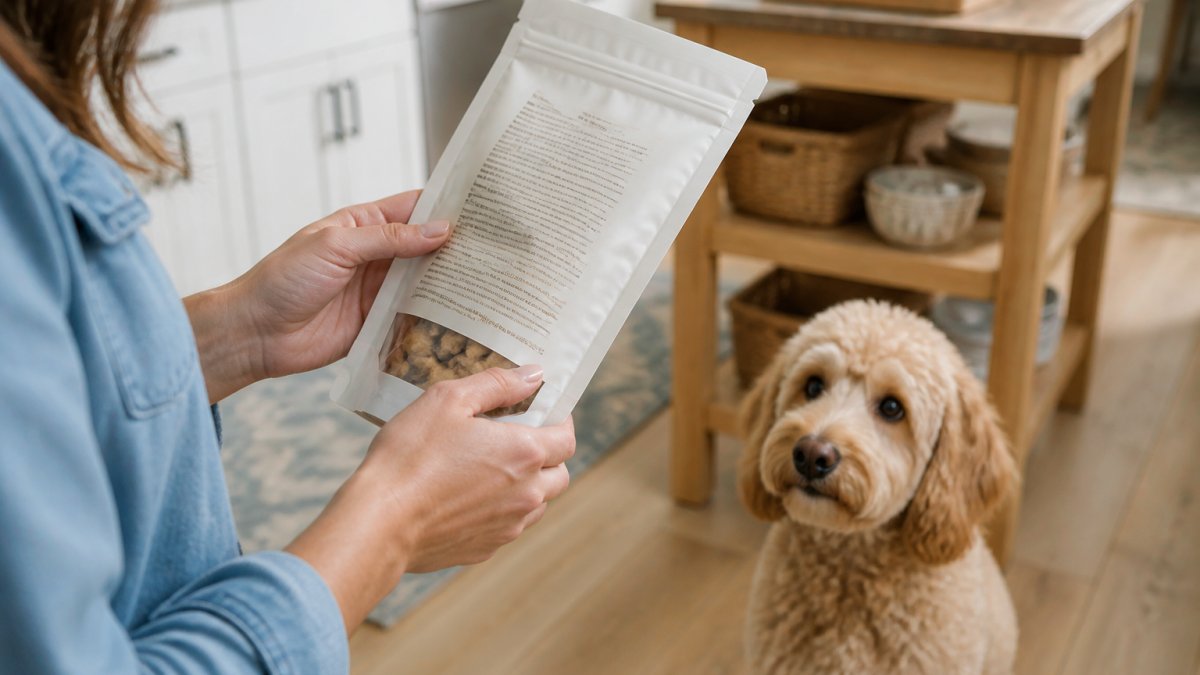
Person reading the ingredient label on a bag of dog treats in a kitchen while a curious dog watches nearby
**1. First, these are guaranteed minimums and maximums, not exact values, so a treat can legally sit anywhere above the protein minimum. Second, the numbers are given on an “as-fed” basis, meaning they include the water in the treat.
2. Check for a calorie statement. Look for a line reading “kcal ME/kg” or “kcal ME per treat” (ME means metabolizable energy).
3. Read the ingredient list with splitting in mind. Ingredients are listed by weight before cooking, and manufacturers can split one ingredient into several entries to push it lower on the list.
4. Look for a nutritional adequacy statement. Treats are not required to be complete and balanced the way full diets are, and most are not (the FDA). That is fine, treats are a supplement to the diet, not a replacement.
5. Verify claims that have rules behind them. “Organic” should carry a USDA Organic seal; without the seal, the word is marketing.
What Package Claims Actually Mean
“Natural” generally means nothing artificial was added, but it says nothing about quality or sourcing. “Organic” should carry a certification seal you can verify. “Limited ingredient” is only meaningful if the list is genuinely short. Our advice: trust the panel, not the banner. If a claim cannot be checked, treat it as decoration.
How Many Treats Can a Dog Have Per Day?
Treats should make up no more than about 10 percent of a dog’s daily calories, a guideline widely used by veterinarians. The useful part is not the number itself but the arithmetic behind it, because “a handful” means very different things for a 10-pound dog and an 80-pound dog. Here is how to actually run the math.
Step 1: Estimate daily calories. Your dog’s daily calorie need depends on weight, age, activity, and whether they are spayed or neutered.
Step 2: Take 10 percent of that number. That is your daily treat budget in calories. A dog on a 600-calorie-per-day plan has a 60-calorie treat budget. A dog on a 1,200-calorie plan has 120 calories to spend.
Step 3: Divide by the treat’s calories. This is where the calorie statement from the label earns its keep. If a treat is 30 calories, a 60-calorie budget is two treats a day. If the same dog gets a 10-calorie training treat, that budget stretches to six.
Large Crunchy Dog Treats – 6 Bakery-Inspired Flavors, All-Natural & USA-Made →
Step 4: Count everything. Training rewards, dental chews, pill pockets, table scraps, and the biscuit your neighbor gives over the fence all come out of the same budget. A common pattern is a dog who eats a careful diet and still gains weight because the treats were never counted.
Practical shortcuts. Break larger biscuits into halves or quarters so one treat becomes several rewards. Use a portion of the daily kibble as training rewards for a dog who is food-motivated, it costs nothing against the treat budget. For a dog who needs to lose weight, drop the treat budget below 10 percent and lean on lower-calorie options such as small pieces of plain cooked chicken or a single ingredient vegetable treat, and confirm the plan with your veterinarian.
Watch the treat size, not just the count. A large biscuit can be 50 to 100 calories or more, which is a big share of a small dog’s daily budget. A tiny training treat may be 3 to 10 calories.
The treat budget math comes down to a few figures you can pull straight off the bag.
Item | Value | Note |
|---|---|---|
Share of daily calories from treats | About 10 percent | Guideline widely used by veterinarians |
Example daily calorie plan | 600 calories | Yields a 60-calorie treat budget |
Example daily calorie plan | 1,200 calories | Yields a 120-calorie treat budget |
Treat at 30 calories | Two treats a day | Against a 60-calorie budget |
Training treat at 10 calories | Six treats a day | Against a 60-calorie budget |
Large biscuit | 50 to 100 calories or more | Big share of a small dog’s budget |
Tiny training treat | 3 to 10 calories | Count matters less than total calories |
Best Treats for Dogs With Sensitive Stomachs
The best treats for dogs with sensitive stomachs are limited-ingredient, single-protein recipes with no artificial additives. Fewer ingredients mean fewer chances of a reaction, and a named protein makes it easy to isolate what works. Our Crunchy Pumpkin Biscotti Dog Treats use just oat flour, pumpkin, cinnamon, and eggs, and avoid top dog allergens such as wheat, beef, corn, soy, and chicken. For more picks, compare our guide to the best treats for dogs with sensitive stomachs.

Crunchy Pumpkin Biscotti Dog Treats – Limited Ingredients, Big Tail Wags
Match the Treat to Your Dog’s Size, Age, and Chewing Style
Treat suitability changes with the dog, not just the recipe. A large crunchy biscuit suits a strong adult chewer; a senior with missing teeth needs something soft or breakable. Small pups can choke on hard, oversized pieces, and flat-faced breeds struggle with dense chews. Match texture to ability: break large treats into quarters for tiny mouths, and choose soft-baked options for older dogs. Our soft treats buying guide covers dental and chewing needs in detail.
Safety Hazards and Toxic Ingredients Hiding in Treats
The biggest treat hazard is not a bad ingredient list; it is a treat that is the wrong shape or density for your dog. Then there are the toxic offenders: chocolate, xylitol, raisins, grapes, onions, garlic, and macadamia nuts are all dangerous to dogs and should never appear in a treat or a homemade recipe. If a treat claims “human-grade” ingredients, confirm none of these are hiding inside.
Storage, Freshness, and Sourcing You Can Verify
Freshness and sourcing are the two things buyers ask us about most. Store treats in an airtight container away from heat and moisture, and follow the bag’s guidance once it is opened; small-batch treats without heavy preservatives are best used within a few weeks. On sourcing, look for a named facility and a verifiable USA-made claim rather than a vague flag. When switching to a new treat, transition gradually to avoid upset stomachs; our guide on how to transition dogs to new treats safely walks through the process.
Stock Your Treat Jar With Small-Batch Options
We make our treats in small batches in Donora, Pennsylvania. Our Large Crunchy Dog Treats come in six bakery-inspired flavors, are breakable for seniors and small pups, and contain no artificial preservatives, colors, or flavors. For everyday rewards, our Hi 5 Peanut Butter Banana Treats use just three core ingredients. Compare small-batch versus mass-produced in our full breakdown.

Frequently Asked Questions
What ingredients should I look for in dog treats?
Look for named proteins like chicken, beef, or peanut butter listed first, followed by recognizable whole foods such as oats, pumpkin, or banana. A short ingredient list is a good sign. Treats with limited ingredients and no artificial preservatives, colors, or flavors are easier to evaluate. The Dog Emporium’s Hi 5 Peanut Butter Banana treats, for example, use just three core ingredients: oat flour, peanut butter, and banana.
What ingredients should I avoid in dog treats?
Avoid vague terms like meat by-products or animal digest, artificial colors such as Red 40 or Yellow 5, artificial preservatives like BHA, BHT, and ethoxyquin, and added sugars including corn syrup and molasses. Also skip treats containing xylitol, which is toxic to dogs, and watch for propylene glycol. These dog treat ingredients to avoid are common in low-cost products, so reading the label before buying matters.
How many treats can a dog have per day?
Treats should make up no more than 10 percent of your dog’s daily calories. For a 20-pound dog eating about 700 calories a day, that is roughly 70 calories of treats. Check the calories per treat on the package and do the math. The Dog Emporium’s Pawfect Pumpkin treats suggest 1 to 3 treats per 20 pounds of body weight as a snack, not a meal replacement.
Are grain-free dog treats better for dogs?
Not automatically. True grain allergies are rare in dogs; most food sensitivities involve proteins like chicken or beef. Grain-free treats can help if your vet has diagnosed a grain allergy, but otherwise they offer no proven advantage. Focus on limited ingredients and named proteins instead. The Dog Emporium’s treats avoid wheat, corn, soy, beef, and chicken in select flavors, which helps if you are isolating a sensitivity.
How do I choose treats for a dog with a sensitive stomach?
Start with a limited-ingredient treat that avoids your dog’s known triggers, often chicken, beef, wheat, or corn. Introduce one new treat at a time over several days and watch for changes in stool or appetite. Soft or breakable textures are easier on older dogs. The Dog Emporium’s Soft Peanut Butter Biscotti and Pumpkin Biscotti are baked in small batches with simple ingredients and no wheat, beef, corn, soy, or chicken.
How can I tell if a dog treat is healthy?
Read the full ingredient list, not the front-of-bag claims. A healthy treat has named ingredients you recognize, a short list, no artificial colors or preservatives, and a stated calorie count. Check for a guaranteed analysis and a manufacturer name and address. Treats from small-batch bakers like The Dog Emporium can be easy to assess when they list simple ingredients such as oat flour, pumpkin, and cinnamon.
Choosing treats that are actually good for your dog comes down to reading the panel, matching texture to your dog, and buying from a source you can verify. The Dog Emporium bakes all-natural, limited-ingredient treats in small batches in Pennsylvania, with breakable options for seniors and small pups and simple recipes gentle on sensitive stomachs. Start shopping with The Dog Emporium and give your dog a treat you can feel good about.

Leave a Reply