
Table of Contents
- Why Your Dog’s Anxiety Needs a Plan, Not Just a Product
- How to Calm an Anxious Dog: A Step-by-Step Behavior Plan
- Natural Calming Supplements for Dogs: Herbs, Amino Acids, and Omega-3s
- CBD for Dogs With Anxiety: What to Know Before You Buy
- Calming Treats for Anxious Dogs: How to Pick and Use Them
- Matching Natural Calming Solutions to Your Dog’s Anxiety Type
- When Natural Approaches Aren’t Enough: Red Flags and Vet Guidance
- Conclusion: Building a Calmer Routine With Natural Calming Solutions
- Frequently Asked Questions
Last Updated: October 9, 2026
Why Your Dog’s Anxiety Needs a Plan, Not Just a Product
Natural calming solutions for anxious dogs work best when they support a behavior plan rather than replace one. At The Dog Emporium, we have watched owners buy a chew, a collar, or a spray, use it once, and conclude nothing works.
Canine anxiety is a persistent stress response to a trigger, not a one-off reaction. It shows up as pacing, panting, hiding, or destructive chewing, and rarely resolves on its own.
Stress Signals Most Owners Miss
The most commonly missed signals are the quiet ones: lip licking, yawning when nothing is tiring, whale eye (the whites showing), tucked tail, and refusing food the dog normally loves.
A common mistake is waiting for a meltdown before acting. Once a dog is over threshold, treats and chews do very little, because a stressed dog often will not eat.
How to Calm an Anxious Dog: A Step-by-Step Behavior Plan
Knowing how to calm an anxious dog starts with a repeatable weekly routine, not a single product. Here is the plan for mild to moderate anxiety.
- Identify the trigger and rate it from 1 (mild) to 5 (panic).
- Set up a calm environment: a covered crate, a white noise machine, a consistent rest spot.
- Add daily enrichment: a sniff-heavy walk, puzzle toys, and chewing time.
- Introduce one calming aid at a time, never three at once.
- Pair the aid with a predictable pre-event routine so the dog learns the sequence.
- Log reactions after each event for four weeks before judging results.
- Adjust one variable at a time, and only after two full weeks of data.
The order matters. Calming aids work better on a dog whose baseline stress is already lower, which is what enrichment and exercise provide.
Pairing Calming Aids With Desensitization and Counterconditioning
A thunder-phobic dog might hear a recording at low volume while receiving small pieces of a high-value treat. The volume rises only when the dog stays relaxed.
This is slow work, and the part most owners skip. A chew given during a storm does nothing if the dog has never learned that storms predict good things.
Tracking Progress: What to Measure Each Week
Measure behaviors, not feelings. Each week, log:
- Recovery time after the trigger ends
- Number of early stress signals observed
- Whether the dog ate during the event
A dog that recovers in ten minutes instead of forty is improving, even if it still reacts.
Natural Calming Supplements for Dogs: Herbs, Amino Acids, and Omega-3s
Natural calming supplements for dogs fall into three rough groups: herbs, amino acids, and fatty acids. They are not interchangeable, and the evidence varies widely. Here is a practical way to sort them, plus the safety questions most owners never ask.
Grading the Evidence: What’s Actually Supported
Sort remedies into three tiers rather than treating them as equally valid.
Better-supported for situational anxiety:
- L-theanine, an amino acid found in tea. It is the most consistently discussed option for mild, situational stress, described as calming without heavy sedation. Onset is typically 30 to 90 minutes, so timing before a known stressor matters.
- Alpha-casozepine, a milk-protein-derived peptide used in some veterinary calming products, often grouped with L-theanine as a first-line non-drug option for mild cases.
Modestly supported, mostly for general brain and mood health:
- Omega-3 fatty acids (EPA and DHA), better supported for overall brain health and long-term mood support than for acute anxiety. Owners report gradual changes over weeks, not minutes. This is a maintenance ingredient, not an emergency one.
Traditional or anecdotal, with thinner formal evidence:
- Chamomile and valerian root, long-standing traditional calming herbs. Many practitioners use them, but formal evidence in dogs is limited and doses are not standardized.
- Lavender, passion flower, and L-tryptophan, common in calming blends, with effects described anecdotally rather than demonstrated in controlled studies.
Use with real caution:
- St. John’s wort, interacts with a long list of medications, including some used in veterinary medicine. Not a casual add-on.
A useful rule: the further down this list you go, the more you should treat the product as a trial with a defined start and review date, not a guaranteed fix.
Dosage Reality: Why There Is No Universal Number
There is no universal dose for herbal calming supplements. Body weight, age, liver function, kidney function, and existing medications all change the picture. A common mistake is scaling a human dose down by weight, which can overshoot badly for herbs with narrow safety margins.
What you can do instead:
- Start at the low end of the label range for your dog’s weight, not the middle.
- Give one new product at a time, with at least 7 to 14 days between introductions, so you can attribute any change.
- Log the dose, the time given, and the response for at least two weeks before judging it.
- Recheck with your veterinarian before stacking two calming products, even “natural” ones.
Safety by Dog: Who Needs Extra Caution
Some dogs should not be given certain calming supplements without veterinary sign-off:
- Pregnant or nursing dogs, most herbal calming products have not been evaluated for safety in pregnancy or lactation.
- Puppies and seniors, both have different liver and kidney clearance than healthy adults, so standard label doses may not fit.
- Dogs on medication, seizure, heart, thyroid, and some pain medications are the most common interaction concerns. St. John’s wort and CBD are the two most frequently flagged.
Essential Oils: A Specific Toxicity Warning
Essential oils deserve their own caution because they are often marketed as “natural” and safe. Many concentrated oils are toxic to dogs, particularly when applied undiluted, diffused heavily in a closed room, or ingested.
For scent-based calming, a dog-specific pheromone diffuser is safer than a human essential oil blend. If you do diffuse anything, keep the room ventilated, keep the diffuser out of reach, and stop immediately if you see drooling, squinting, wobbliness, or vomiting.
Side Effects: When to Stop
Watch for these and stop the supplement if they appear:
- Vomiting or loose stool within hours of a new supplement
- Unusual drowsiness or wobbliness
- Loss of appetite lasting more than a day
If your dog takes medication for seizures, heart conditions, or thyroid function, talk to your veterinarian before adding anything herbal. FDA guidance on pet supplements and unapproved animal drugs is clear that supplements are not reviewed for safety or effectiveness before sale, which puts the burden of checking on you.
CBD Chews For Extra Large Dogs – 360 mg of CBD Oil – Peanut Butter Banana →
CBD for Dogs With Anxiety: What to Know Before You Buy
CBD for dogs with anxiety is the most requested option we hear about, and the one with the most label confusion. CBD won’t cure anxiety. Many owners find it takes the edge off during storms, fireworks, and car rides, which is a meaningful difference for a dog that normally paces for hours.
Choosing a CBD Product: Potency, Ingredients, and Label Checks
Two things matter most: the milligrams of CBD per chew and the rest of the ingredient list.
Our CBD chews are built around four ingredients: oat flour, peanut butter, banana, and CBD oil infused after baking.

Weight Range | Product | CBD Per Chew | Price |
|---|---|---|---|
Up to 40 lbs | CBD Chews for Small Dogs | 3 mg | $27.00 |
40-80 lbs | 6 mg | $37.97 | |
Over 80 lbs | CBD Chews for Extra Large Dogs | 12 mg | $50.00 |
Give the chew 30 to 60 minutes before a known stressor. Start with one and give it time to work before adding a second, and check with your vet if your dog takes medication.
Calming Treats for Anxious Dogs: How to Pick and Use Them
Calming treats for anxious dogs work best as part of a routine, not as an emergency button.
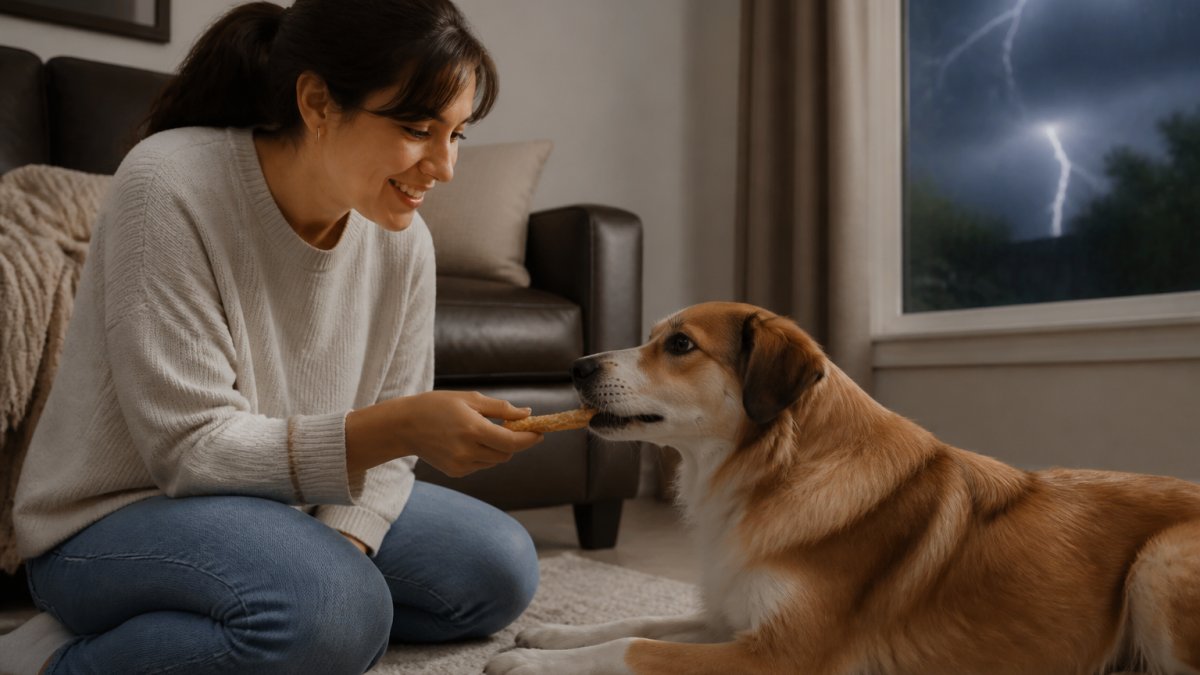
Look for a short ingredient list, a clear milligram dose if CBD is included, and a texture your dog can chew under stress.
Dogs with sensitive stomachs are the toughest case. Limited-ingredient recipes that skip wheat, beef, corn, soy, and chicken remove the most common triggers, which is why we built our chews that way.
Matching Natural Calming Solutions to Your Dog’s Anxiety Type
The right calming solution depends on the trigger, not the breed or size. A chew that helps with a thunderstorm will do almost nothing for a dog that panics when you leave the house, because the underlying driver is different. Use the guide below as a starting point, then adjust based on what you observe.
Why the Trigger Changes the Plan
Anxiety types differ in three ways that matter for product choice:
- Whether the trigger is predictable. Storms, fireworks, and car rides can be anticipated, so a calming aid can be timed. Separation anxiety cannot, because the trigger is your absence.
- Whether the dog will eat when stressed. A dog in full panic often refuses food, which rules out chews and treats as the primary tool during the event.
- Whether the trigger is present or absent. Desensitization only works when you can control exposure. You can control a recording of thunder; you cannot control a real thunderstorm.
Anxiety-Type Decision Guide
Anxiety Type | What’s Happening | First Step | Calming Aid to Add | Timing |
|---|---|---|---|---|
Noise phobia (storms, fireworks) | Sudden, intense, predictable trigger | Safe space plus recorded-sound desensitization at low volume | CBD chew or L-theanine | 30-60 minutes before the event, not at the first boom |
Separation anxiety | Trigger is your absence; peaks after you leave | Gradual absence training, starting with seconds, not hours | Puzzle toy plus daily L-theanine or alpha-casozepine | Daily, not event-based |
Travel or car stress | Anticipatory and motion-related | Short practice trips, positive pairing with the car | Calming chew before departure | 30-60 minutes before leaving |
Vet or grooming stress | Anticipatory, environment-specific | Happy visits to the clinic with no exam | Calming chew plus a familiar mat or towel | 30-60 minutes before arrival |
Generalized, daily anxiety | Persistent baseline stress without a single trigger | Enrichment, exercise, predictable routine | Daily supplement plus veterinary review | Same time each day |
Noise Phobia: Timing Beats Everything
For noise-related stress, a chew given when the thunder starts is late, the dog is already over threshold and often will not eat. The sequence that works: safe space set up in advance, sound desensitization practiced on calm days, and the calming aid given 1 hour or more before the event window opens.
If your dog will not take food during a storm, that signals anxiety severe enough to warrant a veterinary conversation, not a bigger chew.
Separation Anxiety: No Treat Replaces the Training
For separation anxiety, the trigger is your absence and the dog is alone when it peaks, so no chew can be delivered at the moment of highest stress. The work is in the departures: very short absences, repeated, with calm returns. A daily supplement can lower the baseline and a puzzle toy can occupy the first minutes after you leave, but neither substitutes for the training.
Situational Anxiety: Build the Routine Before You Need It
For vet visits, car rides, and grooming, make the sequence predictable. Practice the carrier, the car, or the clinic parking lot on a normal day, pair it with something the dog loves, and only then add a calming aid. A dog that has never been calm in the car will not be rescued by a chew on the way to an appointment.
Generalized Anxiety: The Baseline Is the Target
When there is no single trigger, the target is the dog’s daily baseline: exercise, enrichment, a predictable schedule, and a daily supplement rather than an event-based one. If the baseline does not improve after four to six weeks of consistent effort, bring in a veterinarian for a formal behavioral assessment.
When Natural Approaches Aren’t Enough: Red Flags and Vet Guidance
Natural approaches are not enough when anxiety causes injury, self-harm, house soiling after years of reliability, or a sudden behavior change. Those are veterinary conversations, not supplement conversations.
Sudden anxiety in an older dog that has never been anxious can signal pain, vision loss, or a thyroid issue. Sudden onset in any dog deserves a vet visit before you buy anything. American Veterinary Medical Association resources on behavioral health notes that behavior problems are a leading reason dogs are surrendered, which is why early professional help matters.
A veterinarian can rule out medical causes and, when needed, prescribe anti-anxiety medication. Natural calming solutions can support that plan, but should not delay it.
Conclusion: Building a Calmer Routine With Natural Calming Solutions
The dogs that improve fastest are not the ones whose owners bought the most products. They are the ones whose owners picked a plan, tracked it, and stayed consistent for a month or more.
If you want a simple starting point, our CBD chews are made in small batches in Pennsylvania with four recognizable ingredients, dosed by weight, and soft enough to break for seniors and small dogs.
Frequently Asked Questions
Do calming treats work for anxious dogs?
They can help with mild anxiety, especially when paired with behavior modification. Calming treats for anxious dogs often contain ingredients like L-theanine, chamomile, or CBD, which support relaxation rather than sedate. They work best for situational anxiety such as thunderstorms, fireworks, or car rides. Give them 30 to 60 minutes before the trigger. Severe anxiety usually needs a vet-guided plan alongside treats.
Are natural calming supplements for dogs safe?
Many are safe when dosed correctly, but safety depends on the ingredient, your dog’s weight, and any medications they take. Herbs like valerian root and St. John’s wort can interact with prescription drugs. Always check with your veterinarian before starting natural calming supplements for dogs, especially for puppies, seniors, or dogs with liver or kidney issues. Introduce one new supplement at a time and watch for side effects.
How long does it take for calming supplements to work in dogs?
It depends on the type. CBD chews and L-theanine typically take 30 to 60 minutes for short-term relief. Herbal supplements like chamomile may need consistent daily use for one to two weeks before you notice a change. Omega-3 fatty acids can take four to six weeks to affect behavior. Track your dog’s stress signals daily so you can tell what is actually helping.
Can I give my dog CBD for anxiety along with their regular medications?
Only with veterinary guidance. CBD for dogs with anxiety can interact with medications processed by the liver, including some anti-anxiety drugs and pain medications. Your vet can review your dog’s current prescriptions and recommend a safe starting dose. Never adjust or stop a prescription to try CBD. Start low, monitor behavior, and keep your vet informed about everything your dog takes.
What is the 3-3-3 rule for dog anxiety?
The 3-3-3 rule describes a rescue dog’s adjustment timeline: three days to decompress, three weeks to settle into a routine, and three months to feel fully at home. Anxiety often peaks during the first stage, so keep the environment calm and predictable. Natural calming solutions can support this transition, but give your dog time. Rushing introductions or expecting quick changes can increase stress signals.
When should I take my anxious dog to the vet?
See your veterinarian if anxiety causes self-injury, appetite loss, aggression, or destruction that puts your dog at risk. Also book a visit if natural calming solutions for anxious dogs have not helped after four to six weeks of consistent use. Sudden behavior changes in older dogs can signal pain or illness. A vet can rule out medical causes and discuss prescription options if needed.
Leave a Reply