Table of Contents
- Why a Gradual Transition to New Treats Matters
- How to Introduce New Dog Treats: A Step-by-Step Plan
- How Long to Transition Dog Treats: A Sample Schedule
- How Many Treats Can a Dog Have Per Day?
- Signs of Food Intolerance in Dogs to Watch For
- Choosing Treats for Sensitive Stomachs and Special Diets
- Troubleshooting: What to Do If Your Dog Reacts to a New Treat
- Frequently Asked Questions
Last Updated: October 17, 2026
Why a Gradual Transition to New Treats Matters
A sudden switch to a new treat can upset your dog’s digestive system, even when the treat is high quality, which is why dogs need a slow, steady transition pace.
This is the part most owners miss: treats count as food. A biscotti here and a chew there add up, and switching brands abruptly is still a diet change.
A gradual transition gives your dog’s gut time to adapt and lets you spot a problem early, before it becomes a mess on the rug.
How to Introduce New Dog Treats: A Step-by-Step Plan
Introducing new dog treats safely means starting small and increasing slowly over about a week while you watch for any reaction. Here is the plan we recommend to introduce new dog treats.
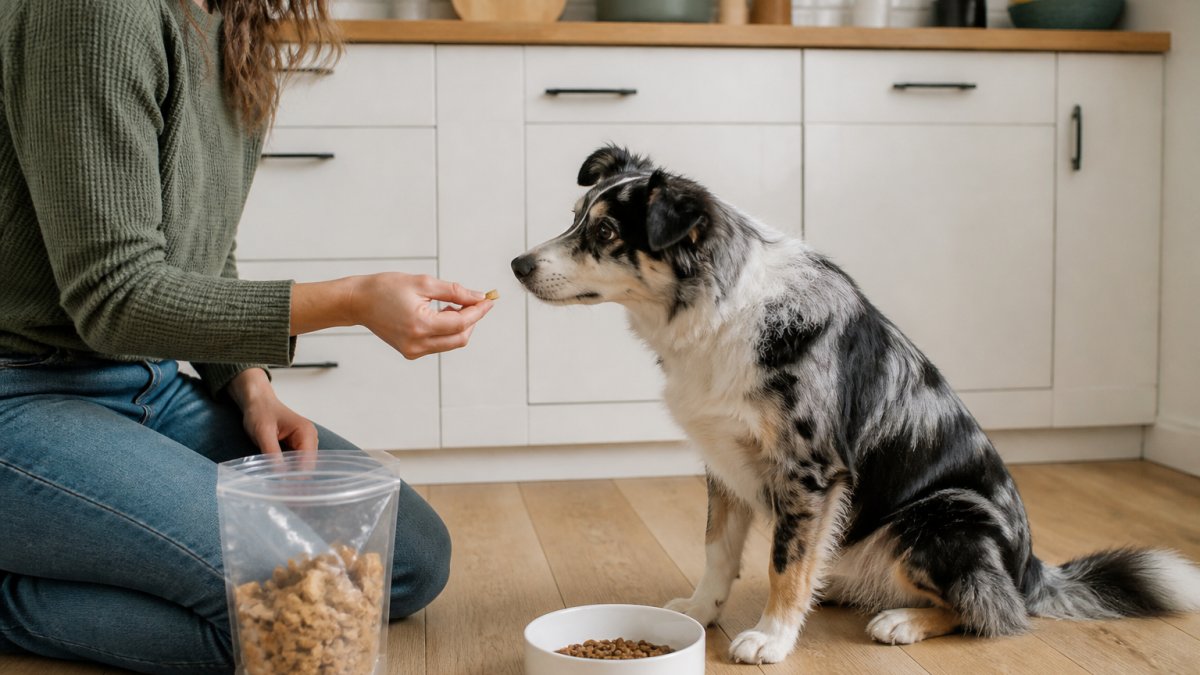
A dog owner kneeling on a kitchen floor offering a small broken piece of a treat to a curious medium-sized dog, with an open resealable treat bag and a bowl of regular food nearby on a bright countertop
Step 1: Start With a Tiny Test Portion
Give one small piece, ideally broken off a larger treat. Watch your dog for the rest of the day. Check the stool on the next walk. A single piece is enough to show whether your dog tolerates the ingredients.
Step 2: Mix Old and New Treats
If the test portion sits well, blend the new treat with the old one, keeping the old treat as the base and adding a little of the new one alongside it.
Step 3: Increase the Proportion of the New Treat
Every two to three days, raise the share of the new treat: roughly 25% new to 75% old, then 50/50, then 75% new. After about a week, most dogs handle the new treat on its own.
How Long to Transition Dog Treats: A Sample Schedule
Most transition dogs do well with a five to seven day switch. Sensitive stomachs may need closer to two weeks. The schedule below is a starting point, not a rule. Adjust the pace based on what you see.
Day | New Treat Share | What to Watch |
|---|---|---|
1 | One small test piece | Stool, appetite, energy |
2-3 | About 25% new, 75% old | Any gas or loose stool |
4-5 | About 50/50 | Stool consistency |
6-7 | About 75% new | Overall comfort |
8+ | 100% new | Confirm steady digestion |
If your dog has a sensitive stomach, stretch each stage by a couple of days. Slow is fine. Fast is where trouble starts.
How Many Treats Can a Dog Have Per Day?
Treats should make up no more than about 10% of your dog’s daily calories, with the other 90% from a complete, balanced food. That 10% figure is the one most veterinarians and veterinary nutritionists cite, and it matters more during a transition because you are often feeding two treats at once.
The practical problem is that “10%” means nothing until you convert it to calories. Here is how to do that without a nutrition degree.
Step 1: Find your dog’s daily calorie target
Your dog’s food bag or can should list calorie content, usually as kcal per cup or can (sometimes written “ME” for metabolized energy). Your veterinarian can give you a daily calorie target based on weight, age, and body condition. A rough starting frame practitioners commonly use for an average, neutered adult dog at ideal weight is about 20 calories per pound per day, adjusted up for very active dogs and down for seniors.
Step 2: Convert the treat label into a per-piece count
Treat bags are required to show guaranteed analysis, and many now show calories as kcal per treat or kcal per kilogram. If the bag gives kcal/kg, divide by 2.2 to get kcal per pound, then weigh a few treats on a kitchen scale to find calories per piece. If the bag gives no calorie information, pick a different treat, you cannot budget what you cannot measure.
Step 3: Do the subtraction
- Add up the calories from meals.
- Subtract that from the daily target.
- Whatever is left is your treat budget, and it should not exceed roughly 10% of the total.
A worked example
A 30-pound dog with a 600-calorie daily target has about 60 calories of treat room. If the new treat runs 15 calories per piece, that is four pieces a day at full share, and during the test phase, one piece of the new treat plus three of the old. Breaking a 15-calorie biscuit into three 5-calorie pieces stretches the same budget across a whole training session.
Sizing treats by dog
- Toy breeds (under 10 lb): pea- to lentil-sized pieces; a full biscuit is often a meal’s worth of calories.
- Small (10-25 lb): a piece roughly the size of a thumbnail.
- Medium (25-60 lb): a piece about the size of a postage stamp.
Our Soft Peanut Butter Biscotti Dog Treats are easy to snap into smaller pieces, which makes portion control simple for puppies and smaller pups.

Soft Peanut Butter Biscotti Dog Treats – All‑Natural, USA‑Made, Puppy to Senior Ready
Treats that are not really “one treat”
Chews, bully sticks, and long-lasting dental chews can carry a surprising calorie load, some run well over 100 calories each, and are often fed in addition to biscuits. If you are testing a new chew, count it as the day’s entire treat budget until you know its calorie content, and cut back meal portions slightly on heavy chew days.
Signs of Food Intolerance in Dogs to Watch For
Signs of food intolerance in dogs usually show up within a day or two of a new treat: diarrhea, vomiting, extra gas, loose or frequent stool, and a drop in appetite. Some dogs also get itchy skin or paw chewing.
Soft Peanut Butter Biscotti Dog Treats – All‑Natural, USA‑Made, Puppy to Senior →
Note the timing: if symptoms appear right after the new treat and clear when you pause it, you have your answer.
Keep a simple log during the transition:
- Date and treat given
- Stool quality that day
- Any gas, vomiting, or itching
Choosing Treats for Sensitive Stomachs and Special Diets
For a sensitive stomach, the best treat is one with a short ingredient list, fewer ingredients mean fewer things that can trigger a reaction. But “short list” is only useful if you know how to read the label and test one variable at a time.
Read the label like a screening tool
Start with the ingredient statement, listed in descending order by weight; the first three to five ingredients tell you most of what you need to know.
Skip treats loaded with artificial colors, preservatives, and long lists of fillers when you are testing a sensitive dog. You want as few novel exposures as possible in a single bite.
Screen for the ingredients your dog already reacts to
The most commonly implicated ingredients in canine adverse food reactions include beef, chicken, wheat, corn, soy, and dairy. They are the usual suspects to check first when a dog has a known history. If your dog has been diagnosed with a food allergy, the safest treat is built around a protein and carbohydrate your dog has not eaten before, ideally cleared with your veterinarian.
Introduce one new ingredient at a time
This is the rule most owners skip. If you switch to a treat with six new ingredients and your dog reacts, you have learned nothing about which one caused it. Pick a treat with a single novel protein or carbohydrate, test it in a small piece, and wait a few days before adding anything else new.
Match the format to the dog
Treat format is not cosmetic, it changes how fast a dog eats, how much air they swallow, and whether the treat is safe for their mouth.
- Soft and semi-moist treats: easiest for puppies, seniors, and dogs with missing or worn teeth, and breakable for portion control. Downside: often higher in moisture and sometimes sugar or humectants, so check the label.
- Crunchy biscuits: good for scraping light plaque and for dogs who like a satisfying crunch, but harder for small mouths and senior teeth. Always snap them down to size.
- Freeze-dried treats: lightweight, highly palatable, and easy to crumble over food for a picky dog. They rehydrate quickly, so offer water alongside. Because they are concentrated, a little goes a long way on calories.
Our All-Natural Sweet Potato Dog Treats are built on a limited recipe with no wheat, beef, corn, soy, or chicken. Our Hi 5 Peanut Butter Banana Dog Treats use just three ingredients and a medium texture that’s easy to break apart.


Life stage and health conditions change the rules
- Puppies: digestion is still developing, so go slower than the schedule suggests and keep pieces tiny, their smaller calorie budgets mean treat calories crowd out balanced growth food faster.
- Seniors: softer textures are easier on aging teeth and jaws, and older dogs often have reduced kidney or digestive tolerance, so a shorter ingredient list and a lower-fat option are safer bets.
- Dogs on a prescription or therapeutic diet: any new treat can undermine the diet’s purpose. Clear it with your veterinarian first, and ask specifically whether the treat’s protein or fat level conflicts with the prescription.
Troubleshooting: What to Do If Your Dog Reacts to a New Treat
If your dog reacts, stop the new treat and go back to the old one, giving the gut a few days to settle. Once things are normal, retry at a much smaller amount, or try a different treat with a shorter ingredient list.
Here is a quick troubleshooting plan:
- Loose stool: pause the new treat, return to the old one, and retry at a quarter of the previous amount.
- Vomiting or repeated diarrhea: stop the treat and call your vet, especially for puppies or seniors.
- Itching or paw chewing: this points to a sensitivity. Try a limited-ingredient treat that avoids common allergens.
Patience and consistency do most of the work. Adjust the pace to your dog, and let their stool tell you how it’s going.
Frequently Asked Questions
How long should I transition my dog to new treats?
Plan on about five to seven days for a full switch. Start with a single small piece of the new treat alongside the old one, then increase the new treat’s share every two to three days. Dogs with sensitive stomachs may need closer to two weeks. Watch stool quality and appetite at each stage, and slow down if anything looks off. There is no prize for finishing fast; a slower pace costs you nothing and prevents digestive upset.
Can changing dog treats cause an upset stomach?
Yes. Even a high-quality treat is a new combination of ingredients, and a dog’s digestive system needs time to adjust. Common signs include loose stool, gas, and occasional vomiting. That is why a gradual transition matters: small portions let you spot a problem before it becomes a bigger one. If your dog has a history of food sensitivity, introduce the new treat as a single piece and wait 24 to 48 hours before offering more.
How many new treats should I give my dog at first?
Start with one small piece, roughly the size of your thumbnail, and break it into smaller bits if you are using it for training. Wait a full day before offering a second piece. Once you see normal stool and no itching or gas, you can build toward a normal serving. Treats should stay under about 10 percent of your dog’s daily calories, so a 25-pound dog on 700 daily calories has roughly 70 calories of treat room.
What should I do if my dog has a reaction to a new treat?
Stop the new treat immediately and go back to what your dog was eating before. Offer plenty of water and keep meals simple for 24 hours. Loose stool that clears in a day is usually minor; repeated vomiting, bloody diarrhea, facial swelling, or lethargy warrants a call to your veterinarian. Note the treat’s ingredient list so you can compare it with future options, and wait at least a week before trying a different treat with a simpler recipe.
Switching treats shouldn’t feel like a gamble. The right approach is slow, small, and watchful, and the right treat makes it easier. At The Dog Emporium, we bake all-natural, limited-ingredient treats in small batches, with breakable textures for seniors and puppies and simple recipes that go easy on sensitive stomachs. Start shopping and give your dog a treat that agrees with them.
Leave a Reply